

From the invention of the first microscope in the 16th century to today, medicine and its accompanying technology have made great strides. In clinical laboratory testing, particularly in the field of Microbiology, advanced technological infrastructure has become the best ally for physicians in their effort to interpret test results with the highest possible accuracy, aiding in the detection of diseases.
Advanced technology now allows for the automation of many processes in clinical laboratories, significantly improving the quality, accuracy, and turnaround time of results. Automation begins immediately after blood collection, from sample preparation and continues through analysis, data recording, result issuance, and waste management—processes that are now performed automatically on the production line in the most advanced laboratories. As a result, the time required to complete laboratory analysis is significantly improved, while the likelihood of human error is virtually eliminated throughout the entire process, from sample collection to result issuance.
High Technology in Healthcare
"Medicine is no longer practiced with just a stethoscope, as it was a few decades ago. "It requires investments and high technology,"
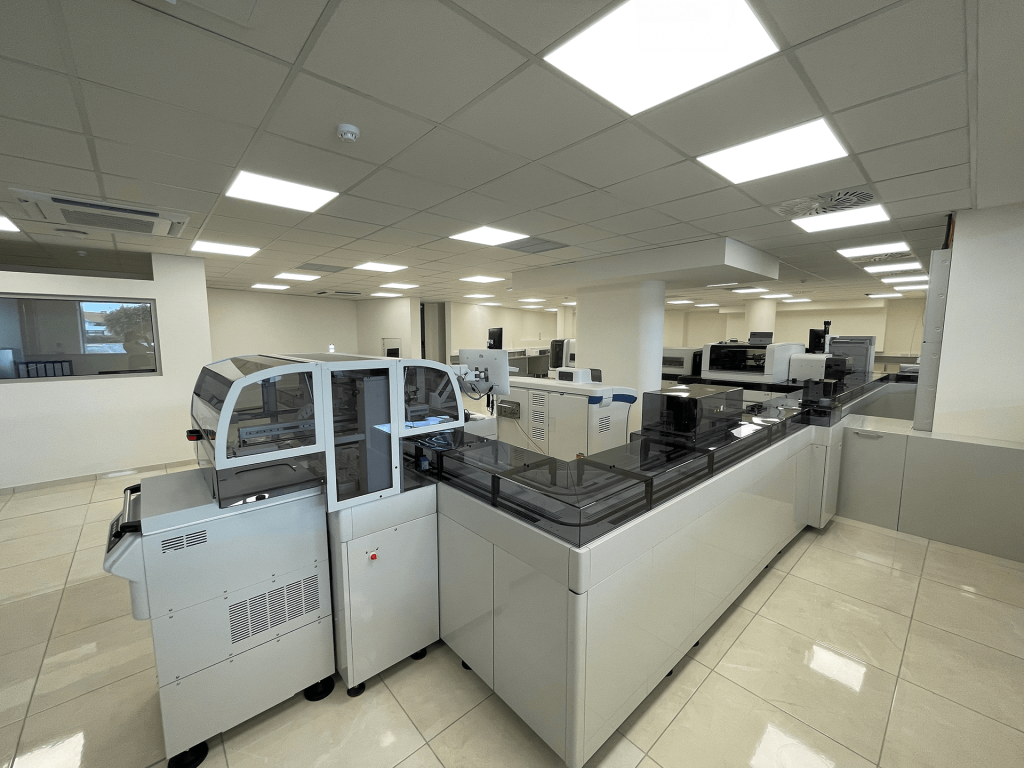
said Evangelos Spanos (1943-2020), founder of the BIOIATRIKI Healthcare Group, in an interview. The Group has been operating in Cyprus since 2017, initially through the acquisition of Yiannoukas Medical Laboratories and subsequently the ALPHA Evresis Imaging Diagnostic Center and Pavlides Medical Laboratories. With a focus on maximizing the use of advanced medical technology, our Group established the most modern, accredited clinical laboratory at Cyprus, the first Polydynamo Diagnostic Center in Nicosia. It features extensive automation, multiple new state-of-the-art medical analyzers covering the full spectrum of tests, innovative software, backup systems for uninterrupted operation, extensive automation in Microbiology, and waste management.
The laboratory was developed in collaboration with leading companies such as SIEMENS Healthineers, INFOMED, Scientronics and more. The fully automated and robotic process impresses visitors to the Center, who, thanks to the open design and use of transparent glass panels, can have full visual access to the automation line, observing the analyzers as they perform their analyses.
Additionally, with the new, fully automated laboratory, the turnaround times for tests are drastically reduced, with the capability to analyze over 600 samples per hour.
This central clinical laboratory receives samples from across the Group’s blood collection centers in Cyprus, as well as from collaborating entities, to be tested according to all required safety, quality, and reliability standards defined by international protocols, with which the Group is certified and accredited.
"the Automation of clinical laboratories is the future technology in the field of Microbiology and represents a significant step towards improving the quality of healthcare services in Cyprus. "Thanks to this, the doctors staffing the laboratories gain a top-notch ally and can respond in the most reliable way to the increasing demands of healthcare systems, providing the highest quality and accuracy in the results they deliver to patients," says Kyriakos Yiannoukas, president of Yiannoukas Medical Laboratories, part of the BIOIATRIKI Healthcare Group in Cyprus.